




Whitepaper
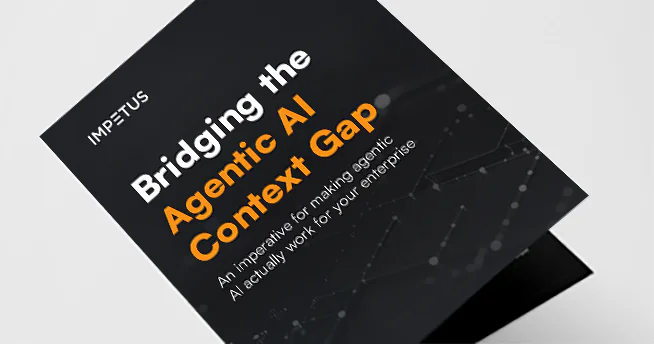
Redefining Financial Services with Context-Aware Agentic AI
With a spotlight on fraud detection and hyper-personalization
Discover how financial institutions can leverage AI agents to improve operational efficiency, mitigate risk, and enhance customer experiences.
Agentic AI is enabling financial institutions to move beyond assistants that answer questions to autonomous systems that execute complex, multi-step workflows. Yet many promising pilots stall in production, not because the models lack capability, but because the enterprise context around them is fragmented, stale, or inaccessible.
This whitepaper explores how context engineering can bridge that gap, grounding AI agents in trusted data, domain knowledge, operational logic, and governance standards so they can deliver reliable outcomes at scale.
Inside the whitepaper
FAQ
1. How can agentic AI add value in financial services?
AI is now moving beyond conventional assistants and chatbots to AI agents that can autonomously reason, decide, and act across complex workflows. In banking and insurance, agents can handle multi-step processes such as fraud investigation, customer onboarding, claims, and compliance, with human oversight for critical decisions. This helps accelerate operations, reduce manual effort, mitigate risk, and improve customer experiences.
2. How is agentic AI different from RPA or traditional AI/ML models?
Robotic process automation (RPA) executes fixed, predetermined steps and can’t adapt to exceptions. Traditional AI/ML models provide predictions (like a fraud score) to support a human decision but stop short of taking action. Agentic AI goes further: it plans and executes multi-step workflows, integrates with tools and systems in real time, and pursues goals autonomously within governance guardrails.
3. How does agentic AI improve fraud detection?
Traditional fraud systems rely on static rules and after-the-fact checks, which can’t keep pace with sophisticated, AI-powered attackers. Agentic AI monitors multiple data streams simultaneously — transactions, device metadata, geolocation, merchant data, and network traffic — and cross-correlates signals in real time to flag anomalies, reducing false positives and catching fraud earlier.
4. How does agentic AI take hyper-personalization beyond traditional approaches?
Traditional hyper-personalization uses historical customer data, predefined segments, and rules to tailor offers and experiences. Agentic AI goes further by combining real-time context with autonomous decision-making, enabling agents to continuously assess customer behavior, identify emerging needs, and proactively determine the next best action. This shifts hyper-personalization from predefined recommendations to dynamic, context-aware engagement.
5. How does regulation affect agentic AI deployment in financial services?
In the US, regulators including the Federal Reserve, OCC, CFPB, and FTC apply risk management and consumer protection rules to AI, requiring model validation, explainability, and audit trails. In the EU, the AI Act classifies applications like credit scoring and lending decisions as high-risk, requiring transparency, human oversight, and documentation.
6. What is Impetus’s approach to agentic AI in financial services?
Impetus uses a repeatable context engineering methodology — delivered through its Leap™ AI Solutions & Services Family — to modernize legacy data (LeapLogic™), build a semantic context layer (Context Fabric™), orchestrate domain-specific agent workflows (Agent Solutions™), and govern everything through a unified control plane (Prism™).